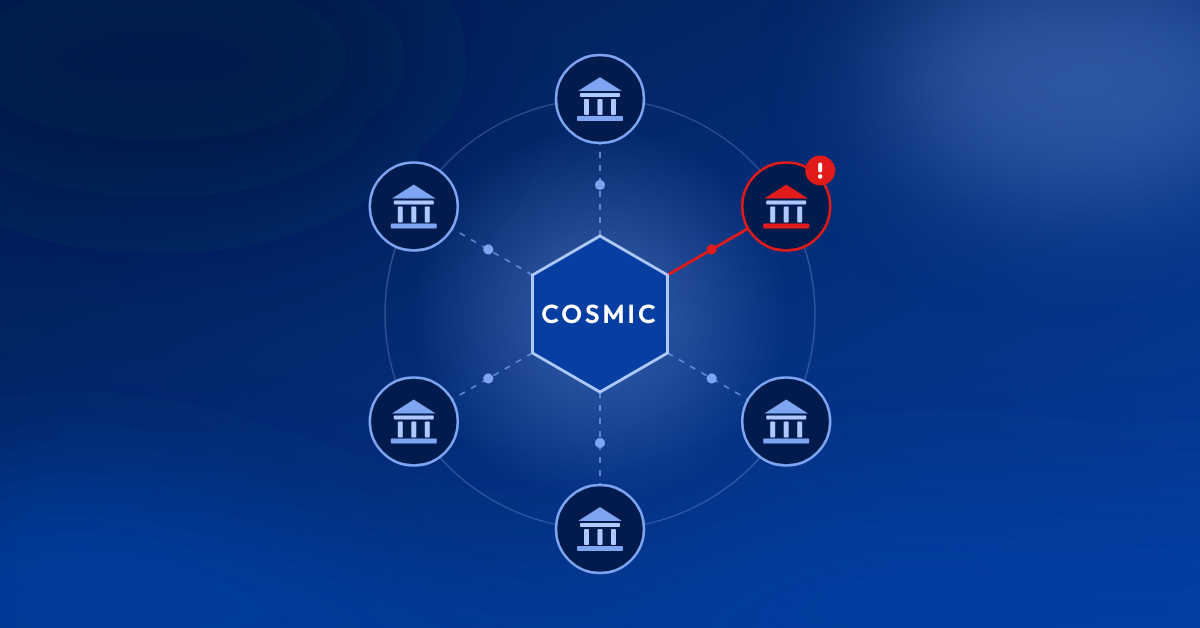
MAS COSMIC transaction monitoring changes who a bank learns from. COSMIC, the Collaborative Sharing of ML/TF Information and Cases platform, launched on 1 April 2024 with six major commercial banks: DBS, OCBC, UOB, Standard Chartered, Citibank and HSBC. It lets participating institutions share information on customers who show multiple red flags once stipulated thresholds are met.
On 5 August 2026 a Singapore minister told Parliament, in a reply published by MAS, that banks on COSMIC have filed additional suspicious transaction reports on the strength of shared information, and that the platform’s expansion is scheduled for completion within two years. In its 6 May 2026 statement on the FATF’s evaluation of Singapore, the Ministry of Home Affairs had said Singapore will expand COSMIC to allow information sharing in significant cases and to include other major banks that are close partners on AML/CFT/CPF matters.
For a bank’s monitoring team, the practical question is not how the platform works at network level. It is where shared information enters local decisions, and what record shows it did.
'/%3E%3Ctext x='410' y='70' text-anchor='middle' font-family='Arial, sans-serif' font-size='30' font-weight='700' fill='%23ffffff'%3EShared signals, local decisions%3C/text%3E%3Crect x='86' y='132' width='165' height='92' rx='18' fill='%23ffffff' opacity='0.92'/%3E%3Crect x='328' y='132' width='165' height='92' rx='18' fill='%23ffffff' opacity='0.88'/%3E%3Crect x='570' y='132' width='165' height='92' rx='18' fill='%23ffffff' opacity='0.84'/%3E%3Crect x='207' y='272' width='165' height='92' rx='18' fill='%23ffffff' opacity='0.86'/%3E%3Crect x='449' y='272' width='165' height='92' rx='18' fill='%23ffffff' opacity='0.90'/%3E%3Ccircle cx='168' cy='162' r='16' fill='%23073EA1'/%3E%3Ccircle cx='410' cy='162' r='16' fill='%23073EA1'/%3E%3Ccircle cx='652' cy='162' r='16' fill='%23073EA1'/%3E%3Ccircle cx='290' cy='302' r='16' fill='%23073EA1'/%3E%3Ccircle cx='531' cy='302' r='16' fill='%23073EA1'/%3E%3Ctext x='168' y='198' text-anchor='middle' font-family='Arial, sans-serif' font-size='17' font-weight='700' fill='%2300184C'%3ECOSMIC signal%3C/text%3E%3Ctext x='410' y='198' text-anchor='middle' font-family='Arial, sans-serif' font-size='17' font-weight='700' fill='%2300184C'%3ECase record%3C/text%3E%3Ctext x='652' y='198' text-anchor='middle' font-family='Arial, sans-serif' font-size='17' font-weight='700' fill='%2300184C'%3ECustomer risk%3C/text%3E%3Ctext x='290' y='338' text-anchor='middle' font-family='Arial, sans-serif' font-size='17' font-weight='700' fill='%2300184C'%3EOwn inquiry%3C/text%3E%3Ctext x='531' y='338' text-anchor='middle' font-family='Arial, sans-serif' font-size='17' font-weight='700' fill='%2300184C'%3EFinding on file%3C/text%3E%3Ctext x='410' y='410' text-anchor='middle' font-family='Arial, sans-serif' font-size='20' font-weight='600' fill='%23AEC9FF'%3EWhere shared information enters%3C/text%3E%3C/svg%3E)
A COSMIC signal becomes part of the bank’s knowledge of the customer, and the bank’s own inquiry and documented finding follow.
COSMIC lets participating Singapore banks share customer information when multiple red flags and stipulated thresholds are met. Notice 626 requires a participating bank to include COSMIC information in its knowledge of the customer and to take it into account when judging unusual transactions, PEP status and higher-risk status.
What COSMIC is and what it covers
COSMIC is a digital platform for secure information sharing between financial institutions. Its legal basis is the Financial Services and Markets Act 2022 as amended in 2023, supported by the Financial Services and Markets (Information Sharing Scheme for Prescribed Financial Institutions) Regulations 2024 and MAS Notice FSM-N02. Notice 626 defines COSMIC by reference to the electronic information sharing system established under section 28N(1) of that Act.
It currently concentrates on three risks in commercial banking: misuse of legal persons, trade-based money laundering and proliferation financing. Information can move in three modes, a request to another participant, a proactive provision of information, and a watchlist alert, with progressively higher red-flag thresholds for each. The details of the thresholds are kept confidential among participants, and only multiple red flags can trigger sharing.
| Element | Detail | Status |
|---|---|---|
| Participants | DBS, OCBC, UOB, Standard Chartered, Citibank and HSBC. | Expanding |
| Risk areas | Misuse of legal persons, trade-based money laundering, proliferation financing. | Expanding |
| Modes | Request, provide and alert, with thresholds rising in that order. | Live |
| Legal basis | FSM Act 2022 as amended in 2023, 2024 Regulations, Notice FSM-N02. | Live |
Where shared information enters Notice 626 decisions
Notice 626 builds COSMIC into monitoring. A bank participating in COSMIC that receives information about a customer, its business, risk profile or source of funds must treat that information as part of its knowledge of the customer (paragraph 6.20). It must take information received through COSMIC into account when deciding whether transactions are complex, unusually large or part of an unusual pattern (6.21), when determining whether a customer is a politically exposed person or a family member or close associate (8.2), and when assessing whether a customer presents a higher risk (8.5).
The Notice keeps the COSMIC platform screening list apart from the lists and information provided by MAS and other authorities for screening (paragraph 6.43(b)). A bank therefore needs to show where shared information entered each of the four decisions, and where it did not.
Knowledge of the customer
Paragraph 6.20.
Unusual patterns
Paragraph 6.21.
PEP determination
Paragraph 8.2.
Higher-risk assessment
Paragraph 8.5.
What MAS has said about results and expansion
In the reply published on 5 August 2026, the minister said COSMIC has enhanced participant banks’ ability to detect bad actors and strengthened the sector’s defences. Information shared on the platform led participant banks to file additional suspicious transaction reports, allowed banks and MAS to identify suspicious networks for timely review, and supported the authorities’ investigations. Expansion is scheduled for completion within two years, and MAS said it will manage it carefully to gain the benefits of sharing while balancing undue de-risking and the confidentiality of customer information.
The reply gives no figures for reports filed or accounts affected, so numbers attributed to COSMIC should not be repeated unless MAS publishes them.
9 May 2023
Second reading of the amending Bill: phased rollout, voluntary sharing in the first phase.
1 April 2024
COSMIC launches with six major commercial banks.
6 May 2026
Ministry of Home Affairs: expand to significant cases and more banks.
5 August 2026
Parliamentary reply: expansion to complete within two years.
The governance questions inside a participating bank
Information from another institution is not information the bank generated or verified. Notice 626 treats it as part of the bank’s knowledge of the customer once received, which raises practical questions about how it is recorded, who can see it and how it changes a customer’s monitoring.
MAS set out its expectations in the 2023 second reading speech. A participating bank should first assess whether there are valid reasons for the customer’s behaviour, and banks are expected to give customers the chance to explain unusual behaviour. After information has been shared, the bank must still make an independent risk assessment and should not rely solely on COSMIC information to end a relationship, including where a customer has been placed on the watchlist.
Banks must also keep shared information accurate and complete and correct errors, particularly where a customer has provided further clarification. MAS said it would monitor how participants use COSMIC information in cases where they exit customers. Participants may not disclose COSMIC information to third parties except in tightly limited circumstances such as court orders or police requests, and MAS and the Suspicious Transaction Reporting Office can see the information shared on the platform.
Signs a bank is not yet governing shared information
Each of these weakens the record a bank can produce.
What to do as expansion approaches
Banks outside the first six should expect the same Notice 626 duties once they participate, because those paragraphs apply to a bank that is participating in COSMIC. MAS said in 2023 that it planned to widen coverage and to make sharing mandatory in higher-risk circumstances in later phases. Four steps can be taken before then.
Tag shared information at source
Record in the case that information came through COSMIC, with the date received.
Decide which signals can change a rating
Set, in advance, how COSMIC information may move a customer’s risk rating.
Keep the bank’s own assessment alongside
Store the independent risk assessment and the paragraph 6.23 inquiry next to the shared information.
Prepare data and case design now
If you expect to join in the expansion, test whether your case tooling can carry external information with its source.
How Nexiant supports shared-intelligence governance
FraudShield, Nexiant’s specialist transaction-monitoring brand, is built around real-time detection, configurable rule logic and case-management workflows. For a COSMIC participant, the useful questions to put to any monitoring capability are whether information from outside the bank can be recorded in the case with its source, whether it can raise a customer’s risk rating through a documented rule rather than a manual override, and whether the bank’s own independent assessment sits alongside it.
Frequently Asked Questions
Govern shared intelligence inside your monitoring programme
Speak with a Nexiant expert about recording and governing external information in monitoring, or explore how FraudShield supports auditable case management.
Speak with an expertThis article was accurate at the time of publication in October 2026 and is intended for general informational purposes only. It does not constitute legal, regulatory or compliance advice. Organisations should seek qualified professional guidance in relation to their specific obligations.